

Kestria’s Global Internal Survey captures insights from senior partners across 40+ countries and 90+ cities. The findings reveal a clear pattern: the value of executive search is shifting decisively toward decision-critical advisory — especially in moments where leadership risk is highest and future readiness is uncertain.
The survey highlights the evolving role of executive search and where true differentiation now resides. Value is increasingly defined by the ability to shape and guide high-stakes leadership decisions, mitigate organisational risk, and help clients appoint leaders who are equipped not only for today’s demands, but to navigate future challenges and opportunities. Together, these trends are reshaping C-suite hiring and leadership strategy globally.
The five insights that follow outline how leadership expectations are evolving — and what this means for organisations navigating 2026 and beyond.
Building on our previous report, The future of executive search and the trends shaping leadership hiring, this year’s insights explore how executive search is evolving into a strategic risk management.
Executive summary (for CEOs / Boards)
Five critical insights define this shift:
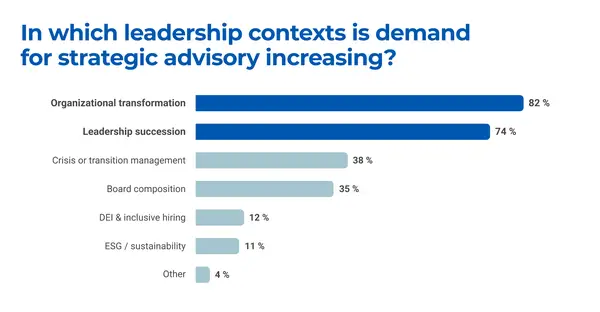
1. Transformation and Succession Are the Two Major “Leadership Risk Moments”: Demand for strategic advisory support is strongest in organisational transformation (82%) and leadership succession (74%). These situations amplify the cost of a wrong decision and require structured leadership decision architecture — not just candidate delivery.
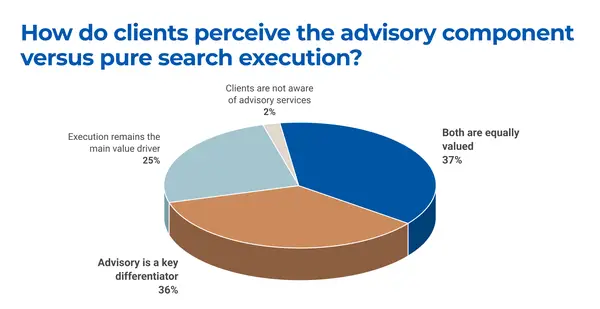
2. Executive Search Is Evolving from “Search Execution” to Decision-Critical Leadership Advisory: Nearly three quarters of respondents report that clients value advisory either equally to execution (37%) or see it as a clear differentiator (36%). The role of the executive search partner is expanding into guidance, market intelligence and stakeholder alignment at the highest level.
3. Future Readiness Has Become a Core Leadership Requirement — Yet Assessment Still Lags Behind: Future capabilities such as strategic agility, systems thinking and AI literacy are increasingly expected in leadership mandates (43% strongly expect; 21% always expect). However, many organisations continue to evaluate primarily on track record, creating a gap between expectation and assessment practice.
4. AI Is the Entry Ticket — Human Intelligence Defines Differentiation: AI adoption is near universal (95%). While technology improves efficiency, it does not guarantee better leadership decisions. Differentiation shifts to judgment, contextual interpretation and the ability to distinguish true leadership capability from surface-level presentation.
5. The Market Is Polarising — Premium Advisory Wins as Delivery Becomes Commoditised: As execution becomes easier to replicate, long-term value migrates toward trusted advisory partnerships. The market is increasingly splitting between high-end retained advisory and commoditised delivery models.
Overall implication:
Executive search has become a form of strategic risk management.
The premium executive search partner is no longer defined by access to candidates, but by the ability to structure complex decisions, assess future leadership relevance, and provide confidence in moments where the stakes are highest.